
What If It’s Not Proof… But Still Changes Everything?
I’ve spent years wrestling with the Shroud of Turin — the faint, haunting image on ancient linen that has drawn pilgrims, scientists, skeptics, and believers for centuries.
Is it the burial cloth of Jesus? Medieval art? A genuine relic of unimaginable suffering? The debate rages on: carbon dating says one thing, bloodstains and forensic details say another, and the image itself remains a scientific mystery.
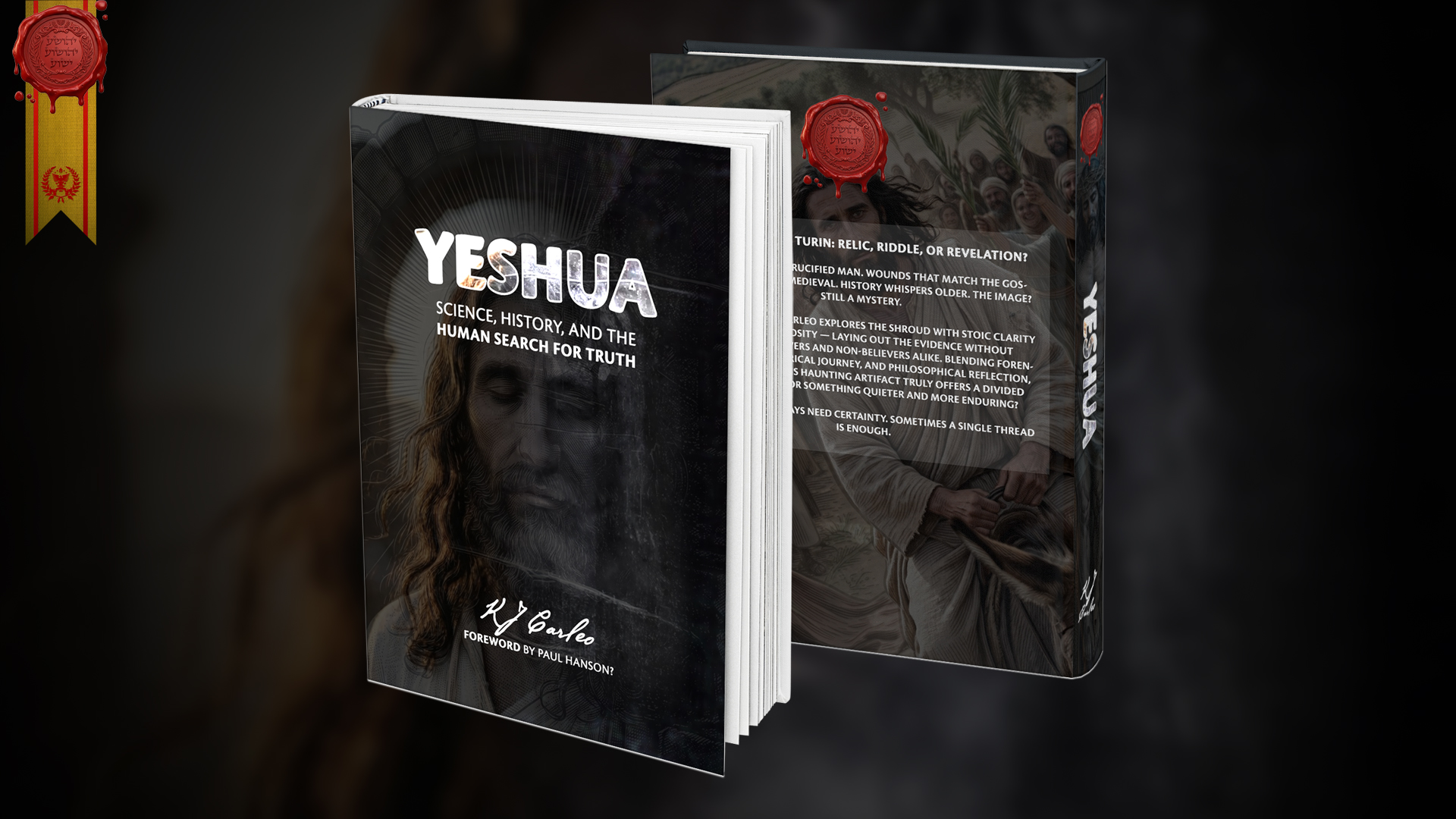
In my forthcoming book Yeshua: Science, History, and Mankind’s Search for Truth, I don’t claim to have all the answers. Instead, I lay out the evidence honestly — for believers and non-believers alike — and explore what this cloth really asks of us.
Today I’m sharing the Afterword (still in draft form — I’ll refine it before publication). It’s the most personal piece in the book: stoic, philosophical, raw in its honesty, and quietly leaning toward hope.
Here’s a taste of what you’ll find inside:
“What if the Shroud isn’t proof? Not of resurrection, not of divinity — just a stubborn echo of endurance…
Yet I lean toward him. Not because I need certainty — stoicism teaches detachment from outcomes — but because the weight feels… right.”
The piece weaves real voices:
- Barrie Schwortz (STURP photographer, a skeptical Jew who spent decades with the cloth): “You don’t have to be a Christian to accept the published science…”
- The STURP team’s own conclusion: the image is “that of a real human form of a scourged, crucified man… It is not the product of an artist,” yet “the answer… remains… a mystery.”
- Pope St. John Paul II: “For the believer, what counts above all is that the Shroud is a mirror of the Gospel.”
- And timeless stoic wisdom from Seneca and Marcus Aurelius on bearing suffering with calm endurance.
This isn’t a sermon. It’s a reflection on what lasts when empires fall, labs rewrite facts, and threads somehow hold.
Read the full Afterword below.
What draws you to the Shroud — the science, the mystery, the hope it offers in dark times? Drop a comment. I read every one.
The book is coming. This is just the beginning.
Stay curious. Stay human.
– KJ
Afterword
What if the Shroud of Turin is not final proof? Not ironclad evidence of resurrection, not undeniable divinity — but something quieter and more enduring: a stubborn echo of human suffering and the will to remember it. A fourteen-foot length of ancient linen that has outlasted empires, fires, floods, skepticism, and every laboratory attempt to dismiss it. It first appears clearly in the historical record in the mid-1300s in Lirey, France, carried by a knight, displayed in a church, and soon challenged by local bishops who called it a painted fake made for profit. Science, through the 1988 carbon-14 dating by three independent labs, places its origin between 1260 and 1390. Newer X-ray and imaging studies sometimes whisper of older possibilities, while DNA traces show a mix — Near Eastern markers alongside Indian and European influences — like a traveler’s passport collected along ancient trade routes. The image itself is only superficial oxidation on the topmost fibers of the cloth: no pigments, no brush strokes, yet strangely flat and undistorted, more like the impression of a bas-relief than the natural wrapping of a human body.
And yet… I lean toward him.
Not because I require certainty — stoicism has long taught that we must practice detachment from outcomes we cannot control. As Marcus Aurelius wrote, “Nothing befalls a man except what is in his nature to endure.” The real test is how we meet what comes. Someone on that cloth bled real human blood — type AB, with elevated bilirubin consistent with severe trauma. The wounds align with Roman crucifixion: flagrum scourging that tore the back and sides, nails driven through the wrists (not the palms, as medieval artists often imagined), a spear thrust to the side, and puncture wounds consistent with a crown of thorns. The face — eyes closed, beard matted — looks back as if it already understands the doubts we bring to it.
I do not come to this as a theologian demanding miracles. I come as a man who has studied history, watched science unfold, and still feels the pull. Barrie Schwortz, the official documenting photographer for the 1978 STURP team and an Orthodox Jew, began his work with deep skepticism. He later reflected: “The only reason I am still involved with the Shroud of Turin is because knowing the unbiased facts continues to convince me of its authenticity.” He also reminded us that science has limits: “Science is obligated to stay within the measurable and the observable, while faith has no such boundaries.”
The STURP scientists themselves — a multidisciplinary team of physicists, chemists, and forensic experts — concluded after 120 hours of direct examination: “We can conclude for now that the Shroud image is that of a real human form of a scourged, crucified man. It is not the product of an artist.” Yet they were equally honest about the limits of their knowledge: “There are no chemical or physical methods known which can account for the totality of the image… Thus, the answer to the question of how the image was produced… remains, now, as it has in the past, a mystery.”
Pope Saint John Paul II, standing before the Shroud in 1998, offered a believer’s perspective without forcing dogma: “For the believer, what counts above all is that the Shroud is a mirror of the Gospel… The Shroud does not hold people’s hearts to itself, but turns them to him.” He saw in it both the reality of suffering and an invitation to contemplate love that willingly endured it.
These voices do not resolve the debate. They deepen it. Empires rise and fall. Gods are reinterpreted. Laboratories rewrite yesterday’s certainties tomorrow. What remains is endurance — the linen threads that held through centuries of handling, fire, and doubt. Seneca captured this stoic truth well: “To bear trials with a calm mind robs misfortune of its strength and burden.” The Shroud does not spare us suffering; it shows us that suffering has been borne before, with dignity, and that something of it was preserved.
I believe — not in blind dogma, not in absolute scientific certainty — but in the quiet practice of standing before the mystery and choosing to keep walking. Hope is not a crown of proof. It is a thread. And threads, however fragile they appear, have a way of holding far longer than we expect.
So let the arguments continue. Let the carbon clocks tick. Let skeptics examine every fiber and believers kneel in reverence. I will sit with this faint, eerie, hauntingly beautiful cloth and reflect: if this is not him, it is close enough. Close enough that the image of shared human pain still moves hearts across centuries.
Again — regardless of whether it is the authentic burial cloth of Jesus or not, what does it ultimately matter? What difference does it make in the grand sweep of history and philosophy? The facts remain messy, the investigation ongoing, the debate endless. But I, for one, believe. Not because every test says “yes.” Not because history speaks with one voice. I believe because of the hope this cloth has quietly given to millions — the way it has kept people faithful, steadied them in their darkest hours, and reminded them that suffering is never entirely solitary.
And when I gaze upon the Shroud… I feel him. That’s all the proof I need.
