
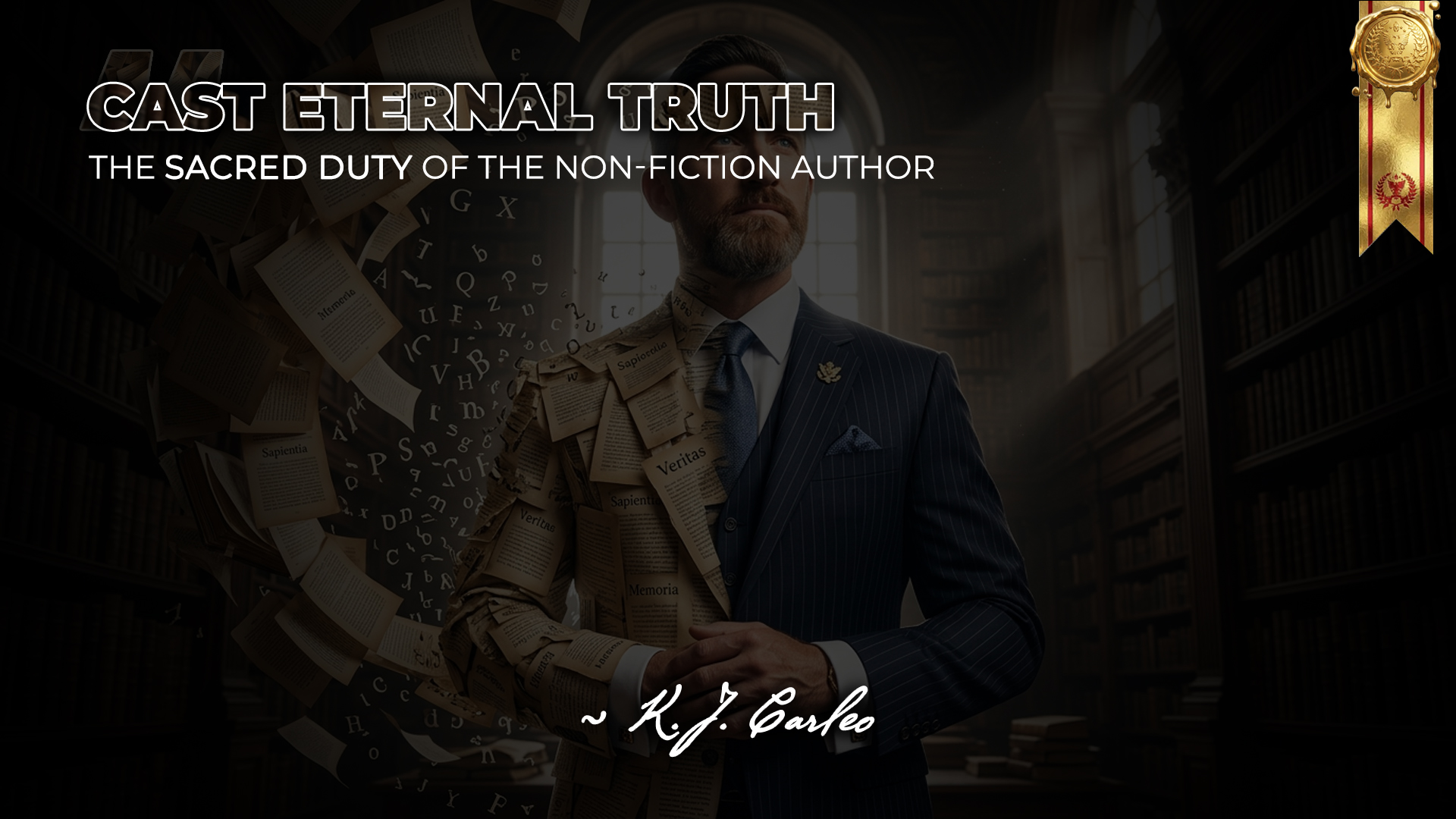
The Sacred Duty of the Non-Fiction Author
🎻 Music Credit: “Promises To Keep” from the Audiomachine album Life (2017).
Composed By Harry Lightfoot.
“If it is not right, do not do it; if it is not true, do not say it.” ~ Marcus Aurelius
To write non-fiction is to accept a sacred duty—one that carries the full weight of a solemn oath. You are not spinning stories from imagination. You are declaring what is. Every word you set down carries the same promise I learned on the yellow footprints at Parris Island and carried through more than two decades in the Corps: This is real. This matters. This is true. You do not get to shade it for effect, omit the hard parts for comfort, or bend it to fit the moment. Break that promise and you do more than damage your own name—you weaken the trust between writer and reader, between one generation and the next.
At the core of this duty is an unyielding commitment to truth. Not the easy truth that sells or flatters, but the stubborn truth that holds up under fire. In Cast Your Light I wrote,
“Do the right thing, for the right reasons, all the time.” ~ KJ Carleo
That same standard governs every page of non-fiction. Readers open your book expecting a clear window onto reality, not a fun-house mirror. They deserve facts tested by evidence, sources verified, and conclusions drawn honestly instead of shaped by wishful thinking. In a world flooded with noise and half-truths, the non-fiction author stands as a quiet counterforce—a steward of clarity, a witness who refuses to flinch.
Integrity is the daily discipline that makes truth possible. It demands you write from honesty, not ego. It asks you to admit your limits, disclose your biases, and reveal the scars and lessons that forged your perspective. Lived wisdom—earned in the crucible of real trials, not borrowed from theory—is the irreplaceable ore you bring to the page. I learned this in the Marine Corps and again in the years since retirement: the words that carry weight are the ones written from the arena, from late nights of doubt, hard conversations, and failures that taught more than any success ever could. When you draw on lived wisdom, your writing breathes. It resonates. It does not merely inform; it lights a path.
And then there is faith. Not ornamental faith, but the deep, quiet faith that undergirds every honest sentence: faith that truth is worth pursuing, worth defending, and worth passing on. Faith that human beings can grow, can heal, and can see clearly when shown the light. In the Acknowledgements of Cast Your Light I thanked God, my Heavenly Father, for the trials and the crucible that strengthened me, and I committed to casting the light He bestowed “both FAR and WIDE.” That same faith keeps you honest when the small exaggeration whispers that no one will notice. It reminds you that you are not writing for today’s trends or tomorrow’s bestseller list. You are writing for the long arc of human understanding.
Consider this: decades from now, long after your name has faded from displays and your social-media following has moved on, some child will pull your book from a shelf or open it on a future device. Maybe she is ten, wide-eyed and curious. Maybe he is fourteen, wrestling with questions of identity, purpose, or pain, looking for solid ground. They will not read with the skepticism of an adult critic. They will read your words and believe them to be true—because you said they were. That belief will shape how they see themselves, how they treat others, and how they navigate joy and sorrow. Your book may become part of the quiet architecture of their conscience.
That is why every line must be worthy of that child, that adolescent, that future seeker. Your work must reach for timeless truth—truth that does not bend with cultural fashions or political winds, truth that still stands when the scaffolding of the present moment has crumbled. Timeless truth is humble enough to acknowledge what we do not yet know, yet bold enough to declare what we have learned through blood, sweat, honest reflection, and lived experience.
In It Is Up To YOU I wrote:
“Truth is the wealth my future self can trust.” ~ KJ Carleo
That same principle applies to every non-fiction page you write. The non-fiction author is more than a recorder of events. You are a bridge between generations, a custodian of memory, a witness whose testimony may outlive you. You are called to “CAST YOUR LIGHT!” not for applause today, but so that decades from now some young reader closes the final page, looks up, and feels the world made a little clearer, a little kinder, a little more true—because you kept faith with the responsibility you were given.
Write as though that child is listening with complete trust. Write as though the truth itself—and the God who is its source—is watching. Write with the integrity that refuses shortcuts, the lived wisdom that refuses abstraction, and the faith that refuses despair.
Your book’s true measure will not be its sales or its reviews. It will be that quiet moment, decades hence, when a young reader finishes the last page and feels their own 30-inch step become a little surer—because you refused to settle for anything less than timeless truth.
Semper Fidelis.
Now go cast your light. The next generation is already reading.
