
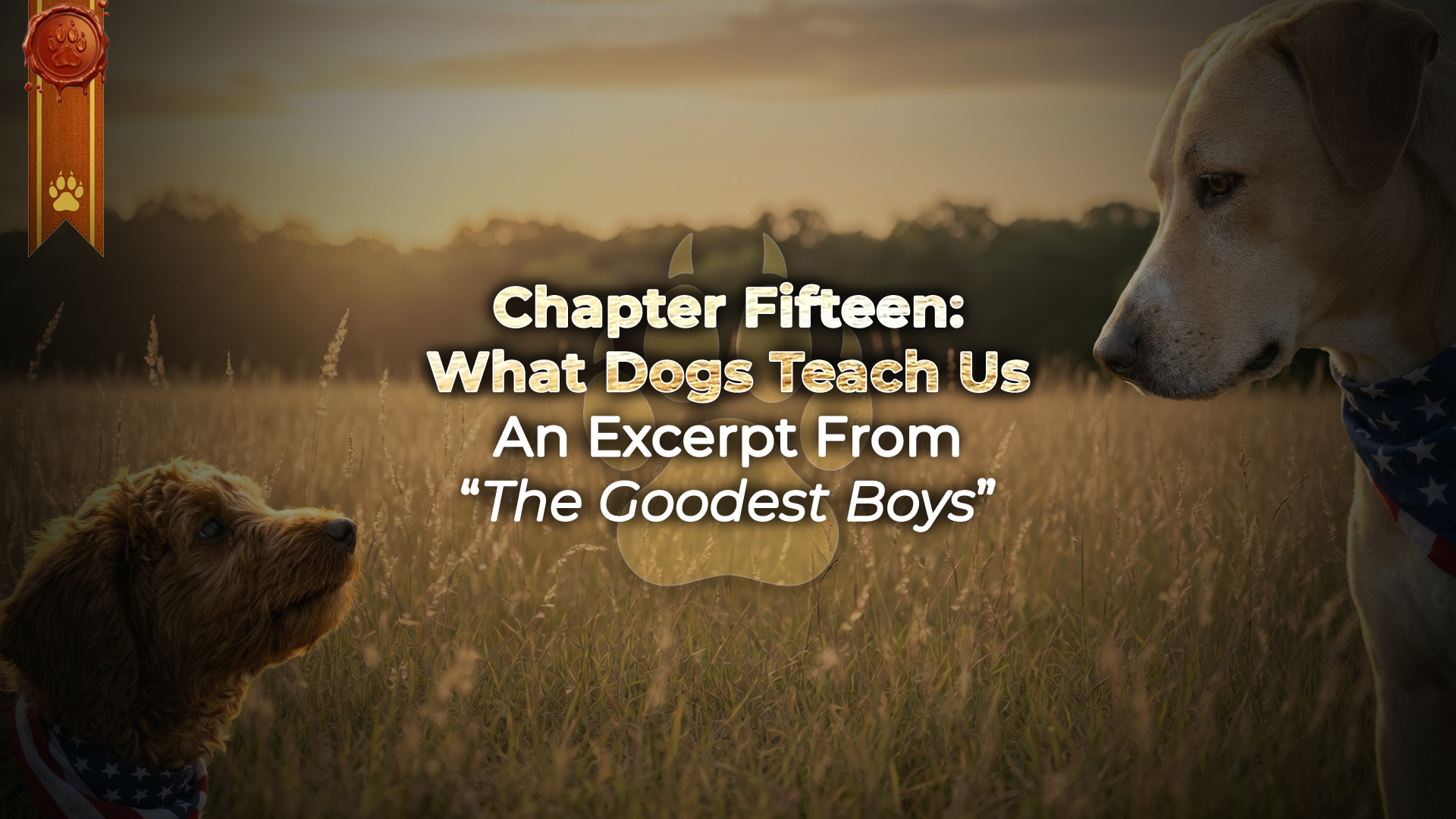
An Excerpt from “The Goodest Boys”
🎻 Music Credit: “I Never Left” by Embers To Stars (Daniel Carleo) — whose masterful cinematic soundscape elevates the message with depth, gravity, and reverence.
Dogs do not explain themselves.
They don’t narrate their intentions or justify their loyalty. They don’t rehearse the past or negotiate the future. They live where they are, fully, and invite us—silently but persistently—to meet them there.
This is their quiet instruction.
When Lincoln was alive, I thought his greatest gift was companionship. I see now that it was orientation. He oriented me toward the present moment in a way no philosophy or discipline ever had. He taught me that attention is an offering, not a transaction. That showing up consistently matters more than showing up impressively.
Caesar continues that lesson, not by repeating Lincoln’s behaviors, but by reinforcing the same posture. He does not demand meaning from what we share. He does not seek explanation. He simply participates. And in doing so, he teaches me—again—that love does not need to be analyzed to be effective.
Dogs grieve without clinging. They bond without bargaining. They forgive without keeping score.
We talk often about unconditional love as an ideal, but we rarely examine what it looks like in practice. Dogs demonstrate it effortlessly. They attach not to our success or our consistency, but to our presence. They do not ask who we were yesterday or who we plan to be tomorrow. They respond to who we are now.
That kind of love is not naive. It is disciplined.
It requires attention. It requires responsiveness. It requires the willingness to stay when distraction would be easier. Dogs model this not through instruction, but through behavior. They wait. They watch. They align themselves with our rhythms and then adjust when those rhythms change.
They teach us how to accompany.
I began to notice how often I failed at this with people. How quickly I reached for solutions instead of listening. How often I treated presence as something to be offered after understanding, rather than as the ground from which understanding grows.
Dogs reverse that order.
Lincoln did not need me to be fixed to be with me. Caesar does not need me to be certain to stay. They simply show up, and in doing so, they reveal how much of what we call love is actually conditional upon comfort.
There is another lesson dogs teach us, though it is harder to accept.
They teach us how to let go.
Lincoln did not fight his leaving. He did not resist the inevitable or cling to what could not be sustained. He accepted his fate with the same composure he had carried throughout his life. That acceptance was not resignation. It was trust.
Trust in the bond we had built. Trust in the care surrounding him. Trust that what mattered had already been exchanged.
That trust reshaped my understanding of loss.
Loss is not always an interruption. Sometimes it is a completion. A closing of a circuit that has already delivered its charge. Dogs seem to know this instinctively. They do not linger in regret. They do not bargain with what cannot be changed.
They move forward carrying what has been given.
This may be the most difficult lesson of all.
We want closure to feel definitive. We want endings to announce themselves clearly, to resolve the discomfort of ambiguity. Dogs show us something quieter: that closure is not a moment, but a posture. It is the willingness to keep participating even when something precious has ended.
Caesar does not mourn Lincoln the way I do. He does not carry memory as weight. He carries it as orientation. He lives from what came before without being bound by it.
Watching him has softened my grip on certainty. It has taught me that continuity does not require sameness. That love can be honored without being frozen. That presence is not diminished by change.
Dogs teach us how to remain open.
They do not guard their hearts against loss. They do not withhold affection out of fear. They attach fully, knowing—somehow—that impermanence is part of the bargain. And yet they do not hesitate.
That courage humbles me.
If this book has taught me anything worth sharing, it is this: the wisdom we search for in theories and doctrines is often already living quietly beside us, waiting for us to notice.
Dogs do not demand that we believe anything. They ask only that we pay attention.
And in doing so, they teach us how to love in a way that survives both presence and absence—without explanation, without defense, without fear.