
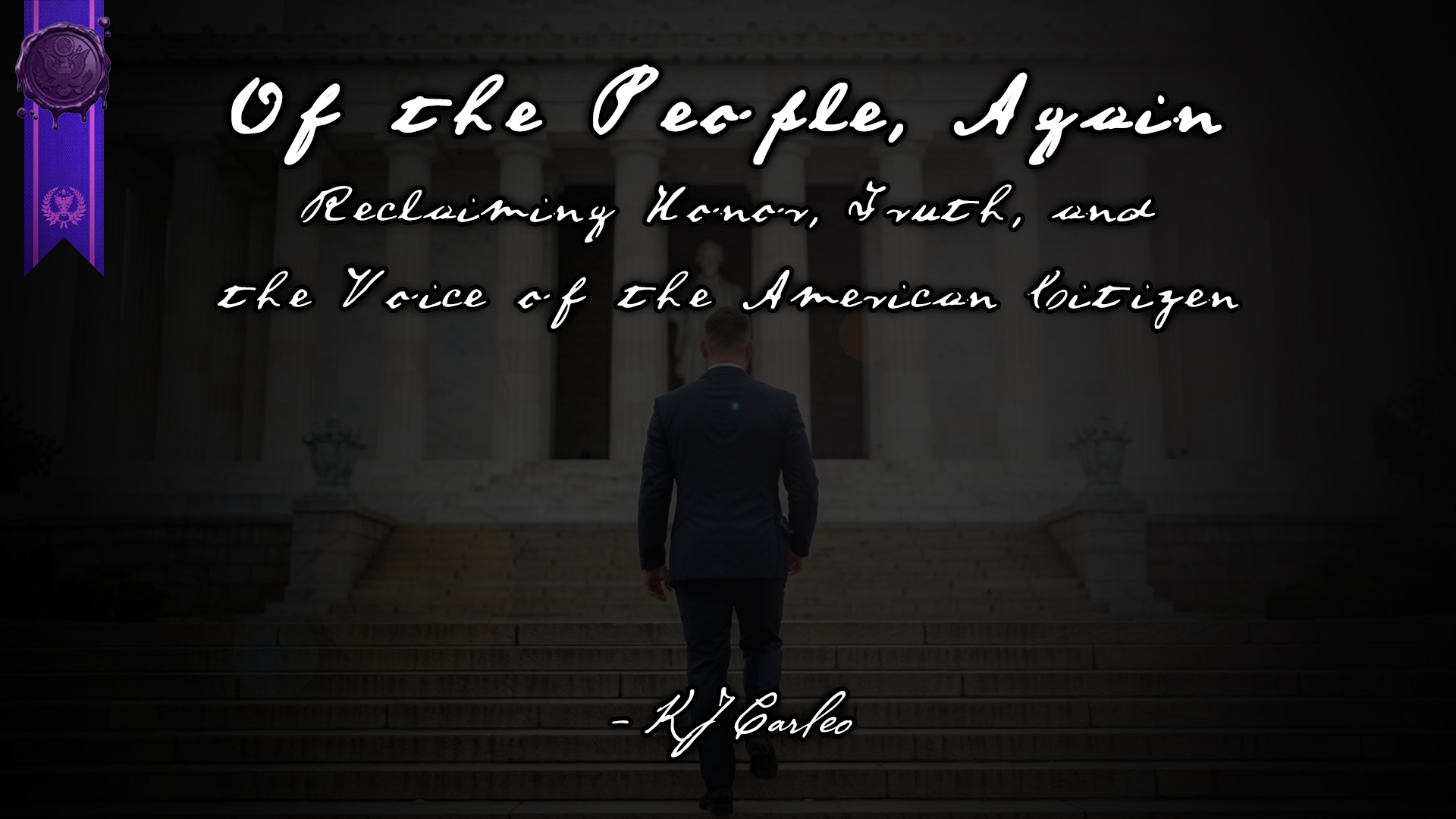
Reclaiming Honor, Truth, and the Voice of the American Citizen
There is a quiet truth many Americans feel but struggle to articulate:
Something foundational has been lost.
Not power. Not influence. Not even prosperity.
But something deeper—honor, dignity, nobility, truth… and the people’s voice.
We have built systems that move faster than our principles. We have amplified noise while muting wisdom. And somewhere along the way, leadership began to drift from service into performance.
But this country was never meant to be led by performance.
It was meant to be led by character.
As Abraham Lincoln once reminded us:
“Nearly all men can stand adversity, but if you want to test a man’s character, give him power.” ~ Abraham Lincoln, 16th President of the United States
Power was never the goal.
Responsibility was.
And responsibility demands truth—even when it is inconvenient, even when it costs something.
Lincoln also said:
“Let the people know the facts, and the country will be safe.” ~ Abraham Lincoln
That principle feels almost radical today.
Because truth has been filtered, shaped, packaged—sometimes even weaponized. But truth, in its pure form, does not need protection. It only needs to be spoken.
And the American people do not need to be managed.
They need to be heard.
“Government of the people, by the people, for the people, shall not perish from the earth.” ~ Abe Lincoln
That was not a slogan.
It was a standard.
And standards require courage to uphold.
We have mistaken cleverness for wisdom. Strategy for leadership. Control for strength.
But Lincoln understood something timeless:
“I am not bound to win, but I am bound to be true.” ~ Abraham Lincoln
Truth is not negotiable.
Not for votes.
Not for power.
Not for convenience.
And without it, trust erodes—quietly at first, then all at once.
Yet even now, there is something stirring.
Not in the halls of power.
But among ordinary people.
People who are tired of spectacle without substance.
Tired of division without direction.
Tired of leadership that speaks at them instead of for them.
People who understand that dignity is not outdated.
That honor is not optional.
That nobility is not weakness.
Lincoln once warned:
“If destruction be our lot, we must ourselves be its author and finisher. As a nation of freemen, we must live through all time, or die by suicide”. ~ Lincoln at his Lyceum Address, 1838
And that destruction does not begin with enemies.
It begins when we stop expecting more from those who lead us.
But expectations are rising again.
There is a growing belief—quiet, steady, undeniable—that leadership can be different.
That someone—not a career politician, not a manufactured figure, but an ordinary, everyday citizen—can step forward with clarity, conviction, and courage.
Someone who does not seek power to hold it, but to restore what it was meant to serve.
Not someday.
Soon.
Because the moment calls for it.
And history has a way of meeting moments like this with unlikely voices.
Lincoln himself reminded us:
“All creation is a mine, and every man a miner.” ~ Lincoln during his lecture on “Lecture on Discoveries and Inventions“, April 1858
Perhaps the future of this country will not be decided by those who have mastered politics…
But by someone who has remembered its purpose.
And when that happens—when honor, dignity, truth, and the people’s voice return to the center of leadership—
It will not feel like something new.
It will feel like something restored.
Author’s Note
This piece was not written in reaction to a moment, but in recognition of a pattern.
Across conversations, communities, and quiet reflection, there is a growing awareness that something essential has drifted—not lost entirely, but displaced. The language of leadership has changed. The expectations have softened. And in many ways, we have learned to tolerate what previous generations would have challenged.
This is not a condemnation of any one person, party, or administration.
It is a call to remember the standard.
A standard rooted not in perfection, but in principle. In truth spoken plainly. In service carried out with humility. In leadership that understands power is not something to possess, but something to steward on behalf of others.
But there is a deeper layer to this.
Nations do not drift on their own.
They reflect the internal state of the people who sustain them.
We often look outward for solutions—toward institutions, leaders, systems—hoping for correction at the top. Yet the most enduring change has always begun somewhere quieter, more personal.
With responsibility.
With perception.
With the willingness to examine not just what is happening around us, but how we are participating in it—through our attention, our expectations, and our standards.
It is easy to believe that leadership is something separate from us. That it exists “out there,” beyond our influence. But a republic does not function that way.
A republic mirrors its people.
When we lower our expectations, leadership follows.
When we tolerate distortion, truth erodes.
When we look away, accountability dissolves.
And equally—
When individuals begin to raise their internal standard, something shifts.
Clarity returns.
Discernment sharpens.
Responsibility replaces blame.
This is not abstract philosophy.
It is practical.
Because the same principle that governs a life governs a nation:
What you tolerate, persists.
What you take responsibility for, transforms.
The ideas expressed here are not new. They are woven into the founding of this country and echoed in the words of those who led it through its most defining trials.
What may be new is the urgency.
History does not always announce its turning points. Sometimes it waits—quietly—until enough people recognize that the direction must change.
And when that recognition takes hold, it rarely begins with those already in power.
It begins with ordinary citizens.
Individuals who choose clarity over comfort.
Responsibility over indifference.
Truth over convenience.
Individuals who understand that light is not something reserved for a few—it is something each person is capable of carrying, if they are willing to see clearly and act accordingly.
This piece is offered in that spirit.
Not as an answer, but as a reminder.
Not as a declaration, but as an invitation.
Because the future of any republic is not decided solely in its institutions—
It is decided in the expectations of its people.
And when those expectations rise, leadership has no choice but to rise with them.
