

A Journey of Stoic Spirituality
🎻 Music Credit: “It Is Up To You” by Embers To Stars (Daniel Carleo) — whose masterful cinematic soundscape elevates the message with depth, gravity, and reverence.
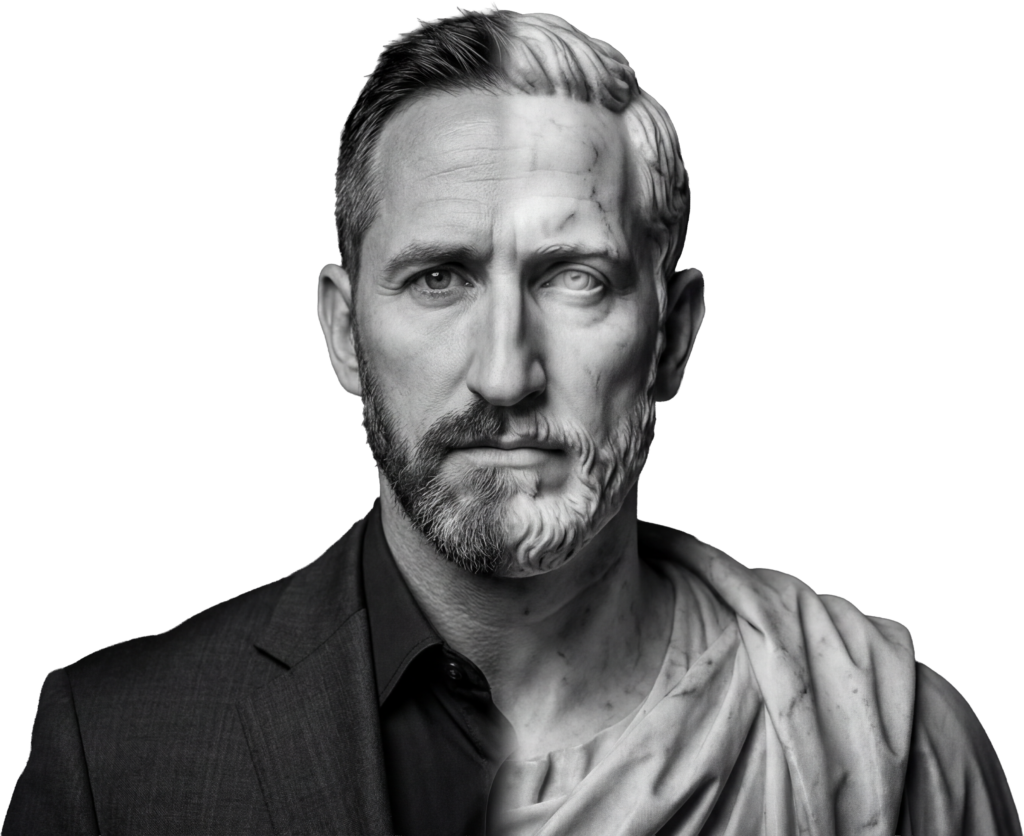
The turning point is not out there — it is in here. It is up to you. ~ KJ Carleo
It took me a long time to discover that no philosophy, no doctrine, and no teacher could walk my path for me. I waited for life to become easier, for people to change, for circumstances to finally align with my plans. They rarely did. What changed instead – slowly, painfully, and then with increasing grace – was the way I met life inside my own mind and heart. This book was born from that discovery: that the turning point is not “out there,” but in here. It is, in the most direct and liberating sense, up to you.
When I first encountered the writings of Marcus Aurelius, I was struck by how intimate they felt. Here was an emperor, alone with his journal, reminding himself to stay humble, to remember what he could and could not control, to meet each day with courage and integrity. He was not composing a system for others; he was fighting for his own soul. Centuries later, I met a very different text, A Course in Miracles, which spoke in the language of forgiveness, inner guidance, and a love that could undo fear. On the surface, these worlds seemed far apart – one grounded in reason and virtue, the other in prayer and miracles. Yet I kept hearing the same invitation spoken in two dialects: your mind can be trained; your perception can be healed.
This book stands at the confluence of those two streams. Stoicism offers us a clear, demanding vision: live in agreement with reason, accept what you cannot control, and let virtue – wisdom, courage, justice, temperance – be your true wealth. Spiritual practice offers us a tender, radical promise: there is something larger than your ego, whether you name it God, Nature, the cosmos, or simply Love, and you can learn to rest your life in that larger presence. “Stoic spirituality,” as I use the phrase here, is the weaving together of these truths. It is the daily work of aligning your thoughts, judgments, and reactions with both reason and reverence, so that you become less tossed by events and more anchored in meaning.
This is not a book of abstract theory. It is a year‑long apprenticeship in perception. Each of the 365 meditations is a small exercise in turning inward and upward at the same time: inward to take responsibility for your own responses, and upward to remember that you do not walk this path alone. Over time, those small, repeated turns reshape you. You begin to notice the space between stimulus and response. You catch yourself loosening your grip on what you cannot control. You experiment with choosing peace where you once chose drama, and courage where you once chose retreat. You discover that serenity is not passivity but a different kind of strength.
You will notice that every meditation speaks in three voices. First, I speak in the first person. This is not to center myself, but to refuse the temptation to preach from a distance. I share my own questions, resistances, and glimpses of clarity so that you remember this is lived, not theorized. Then I turn to you directly. Here the meditation becomes a mirror, inviting you to consider your own patterns and possibilities, to test these ideas against the friction of your real life. Finally, we pray together. In the “we” and “us” paragraphs, we stand side by side and look toward something greater than either of us. We acknowledge that while it is up to us to choose, we also lean on a wisdom and love beyond our solitary will.
You do not need to be a philosopher or a believer to walk this road. You may come from a particular religious tradition, from none at all, or from a place of honest uncertainty. All that is required is a willingness to observe your own mind and a curiosity about what might happen if you stopped waiting for the world to change first. The practices you will meet here – reflection, gentle self‑examination, brief moments of silence, simple prayers – are meant to fit into an ordinary day. They ask for sincerity, not perfection.
If you move through these pages one day at a time, you will not be the same person who began. The change may be quiet. You may simply notice that certain things no longer hook you the way they used to, that your first impulse is a little less reactive and a little more considered, that your sense of isolation softens into a feeling of being carried. You may also pass through seasons of resistance, boredom, or doubt. This too is part of the journey. On those days, the most important practice is simply to show up again.
Wherever you are as you open this book – hurting, hopeful, skeptical, exhausted, or quietly ready – know that you are not late. There is no earlier chapter you were supposed to have read, no version of you that should have arrived by now. There is only this moment, this page, and the next honest step you are willing to take. My hope is that these meditations will walk beside you as a steadfast companion: sometimes challenging you, sometimes comforting you, always pointing you back to the place where your true power lives.
The journey of Stoic spirituality does not promise a life free of difficulty. It offers something deeper: the possibility of meeting whatever comes with a mind trained in clarity and a heart rooted in something larger than fear. If that possibility stirs even a small yes in you, then let us begin.
