
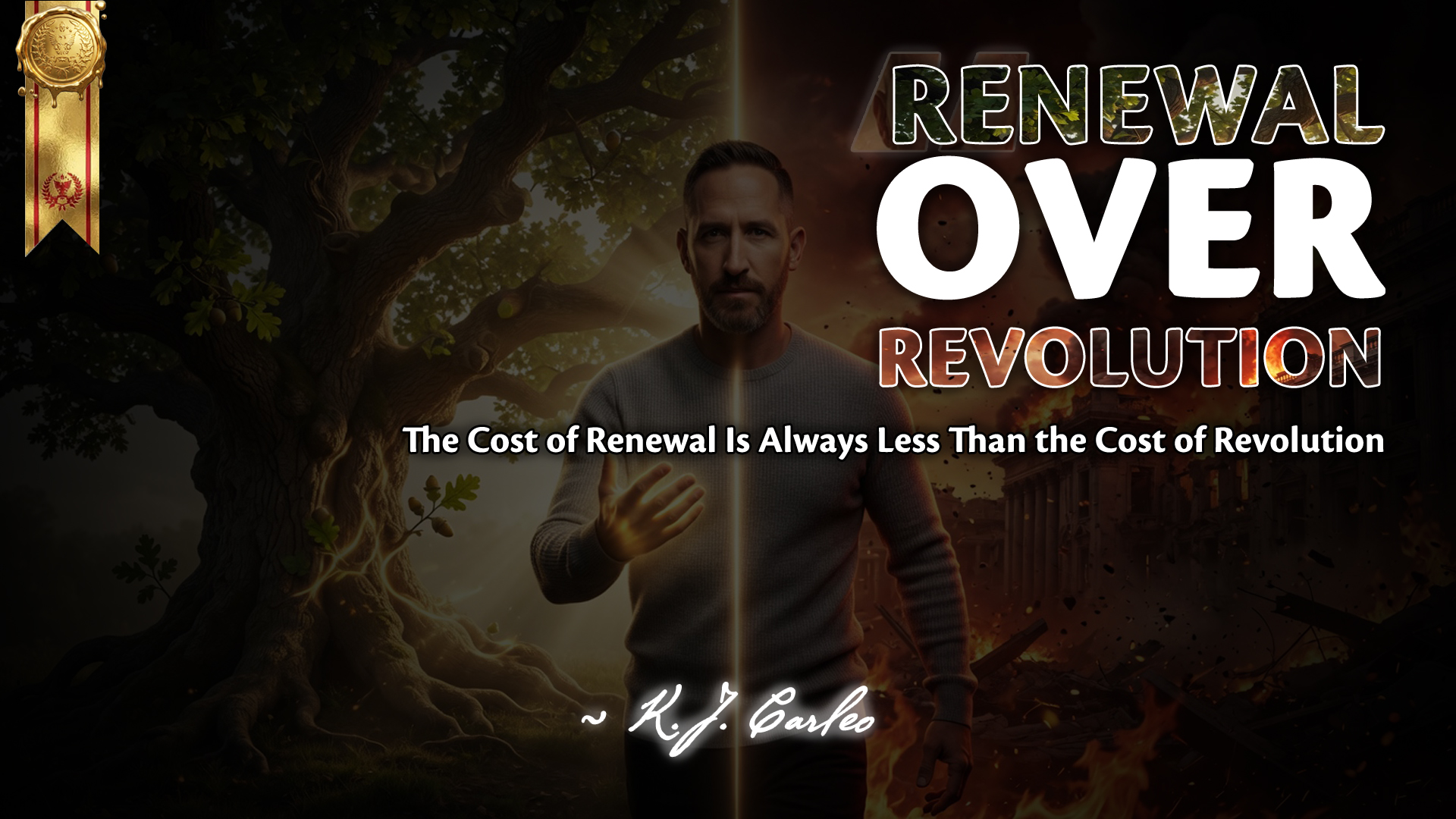
The Cost of Renewal Is Always Less Than the Cost of Revolution
🎻 Music Credit: “Through the Darkness” (Epic Extension) from the album Ascendance (2018).
Composed By Mark John Petrie
History whispers this truth in every age, yet humanity keeps testing it the hard way. Renewal is the quiet, disciplined work of the steward: identifying cracks in the foundation, replacing rotten timbers, reinforcing beams, and painting over weathering before the storm arrives. It demands patience, humility, and the willingness to live with imperfection while making things incrementally better.
“Take a full 30-inch step towards the greatest version of you.” ~ KJ Carleo
Revolution, by contrast, is the act of the arsonist who believes the only solution is to burn the entire structure to the ground and declare a new dawn. The flames are dramatic, the rhetoric intoxicating, but the ledger of costs tells a different story—violence, economic collapse, power vacuums, unintended consequences, and long recovery periods.
“Easy never won wars. Easy is lazy, hopeful, and comfortable. Now hard, hard is determined, faithful, and sometimes uncomfortable. The more you are willing to do the things that are ‘hard’, the easier ALL THINGS become.” ~ KJ Carleo
Renewal measures its expenses in targeted effort—incremental reforms, internal purges of corruption, gradual cultural adjustments, and the slow discipline of accountability. These costs are real but contained. They preserve continuity, institutional knowledge, social trust, and the fragile web of cooperation that makes civilized life possible.
“As you learn to strengthen your willpower, you will revolutionize your way of thinking.” ~ KJ Carleo
Revolution tallies its bill in blood, treasure, and time that no accountant can fully capture. The French Revolution promised liberty, equality, and fraternity; it delivered the Terror, the guillotine, Napoleonic wars, and eventually another monarchy. The Russian Revolution sought to end tsarist oppression and usher in a workers’ paradise; instead it produced Stalin’s gulags, engineered famines, and seventy years of totalitarian misery. Countless other upheavals followed the same grim pattern: ecstatic destruction followed by decades of higher costs than anyone imagined.
“You are equipped with the most powerful weapon ever known to man… Its maximum range cannot be measured; its maximum effective range is determined by YOU… That most powerful weapon is – WILLPOWER.” ~ KJ Carleo
Even when revolution “succeeds” in replacing a truly intolerable regime, the price tag remains exorbitant. The American Revolution is often cited as a rare exception, yet it still required a bloody war, years of economic disruption, and the later trauma of a civil war to finally resolve its deepest contradictions. Most revolutions are not so fortunate. They trade one set of problems for a far more expensive and unpredictable set.
“CAST YOUR LIGHT!” ~ KJ Carleo
The insight is not that change is bad. Stagnation is its own form of slow-motion ruin. The wisdom lies in the timing and method. Renewal asks us to act while there is still slack in the system—while institutions retain legitimacy, while memory of past successes provides confidence, while civil society can absorb shocks. It favors the conservative insight of stewardship: reform with care, or risk killing the patient in the name of curing the disease.
“Your life is YOUR responsibility. It is up to YOU.” ~ KJ Carleo
This principle scales beyond politics. In business, companies that relentlessly renew—adapting products, fixing culture, pruning dead weight—rarely need the “disrupt or die” revolution that leaves employees traumatized and shareholders poorer. In personal life, the person who regularly renews habits, relationships, and character pays the small daily costs of discipline instead of the crushing price of total breakdown and reinvention. In culture and technology, steady iteration usually outpaces the fantasy of year-zero reboots.
“Knowing others is intelligence; knowing yourself is true wisdom. Mastering others is strength; mastering yourself is true power.” ~ Lao Tzu
Of course, there are tragic exceptions. Some regimes or systems become so calcified, so captured by predators, or so hostile to their own people that meaningful renewal is blocked at every turn. In those cases, the cost of attempted renewal may eventually exceed the terrible price of upheaval. But even then, the prudent actor exhausts every realistic path of reform before accepting the revolutionary gamble. The default should always tilt toward renewal, because the hidden costs of revolution—dead sons and daughters, shattered economies, lost decades of progress, cycles of revenge—are almost always higher than the prophets of upheaval admit.
The cost of renewal is always less than the cost of revolution. ~ KJ Carleo
Not because renewal is painless or perfect. But because it honors the accumulated wisdom, capital, and decency already present in a society—or in a life—rather than betting everything on the unproven brilliance of those who would tear it all down. In a world eager for dramatic resets, this remains one of the most quietly radical and deeply humane ideas: fix what you have, while you still can, before the fire becomes the only option left. The house you save may not be flawless, but it will still be standing when the smoke clears.
“See yourself with the good that you desire.” ~ Florence Scovel Shinn
